← Blog · 📝 Article · 11 September 2026
30–35% of Favourites Win: Selection First Laying Favourites Strategy

Laying favourites can be profitable, but only when you target weak or false favourites rather than laying every market leader. Selectivity is the entire strategy: favourites win somewhere between 30 and 35% of races, which means indiscriminate laying will drain your bank. The rest of this guide covers how to pick the right ones, calculate liability properly, and time your execution without letting a single bad race wipe out weeks of gains.
TL;DR:
- Only lay weak or false favourites, as horse racing markets show favourites win roughly 30 to 35% of races, making indiscriminate laying costly.
- Spot false favourites by analyzing recent form, ground compatibility, trainer and jockey changes, headgear adjustments, and context like race type and field size.
- Proper liability management involves calculating potential losses accurately and using fixed or percentage staking strategies to avoid wipeouts during losing streaks.
- Timing entries carefully when the favourite drifts in price during the last 30 minutes before the race can maximize profit and reduce risk.
- Using algorithmic signals and record-keeping helps identify genuine edges and maintain discipline, especially when scaling up your betting over a substantial sample size.
Table of Contents
- How to identify weak and false favourites
- Liability and staking: the maths every layer must master
- Execution: timing, market monitoring and practical tools
- Common errors, psychology and record keeping
- DonkeyRadar evidence: how algorithmic signals and verified results support practical laying
- Author perspective: when I use laying and when I sit it out
- How DonkeyRadar can help: guides, calculator and trial
- Further reading and primary sources
- Sources
How to identify weak and false favourites
A weak favourite is a horse sent off top of the market on modest ability, usually because the field itself is poor. A false favourite is different: it looks strong on paper but carries a hidden problem, such as unsuitable ground or a step up in distance, that the betting market hasn’t fully priced in. Spotting the second type is where the real edge sits.
Run through this before backing any lay:
- Recent form: three or more runs without a top-three finish, especially against similar-grade opposition, is a red flag.
- Course and trip suitability: a horse with no proven form at the distance or track is more vulnerable than the odds suggest.
- Trainer and jockey context: a booking swap, a yard in poor form, or a jockey unfamiliar with the horse all add risk.
- Headgear changes: first-time cheekpieces or a blinkers removal often signals that the yard is masking a behavioural issue, not fixing one.
- Class and weight: a favourite carrying a big weight rise off a easy win in a weaker race is a classic false-favourite pattern.
- Going mismatch: a confirmed soft-ground horse dropped into quick conditions (or vice versa) rarely runs to form.
Market behaviour adds a second layer of evidence. Heavy support in the closing minutes before the off tends to reflect informed money, while a favourite that drifts steadily from an early price is often being avoided by people who know something you don’t. Recreational money piling onto a short price late in the day, particularly on televised meetings, can also inflate a price beyond what the form justifies.
Race context matters as much as the horse. Large-field handicaps, testing ground and maiden races throw up the most laying value, because form is harder to read and market prices lean on reputation rather than genuine data. Small-field Grade races or specialist events (novice hurdles with one standout, for example) are far riskier: there’s often a legitimate reason one horse dominates the market, and the reason is usually that it’s the best horse in the race.
Pro Tip: Build your own tick-box version of this checklist and score each runner out of six before you touch the lay button. A favourite failing four or more boxes is a genuine candidate; one failing only one or two probably isn’t worth the liability.
Liability and staking: the maths every layer must master
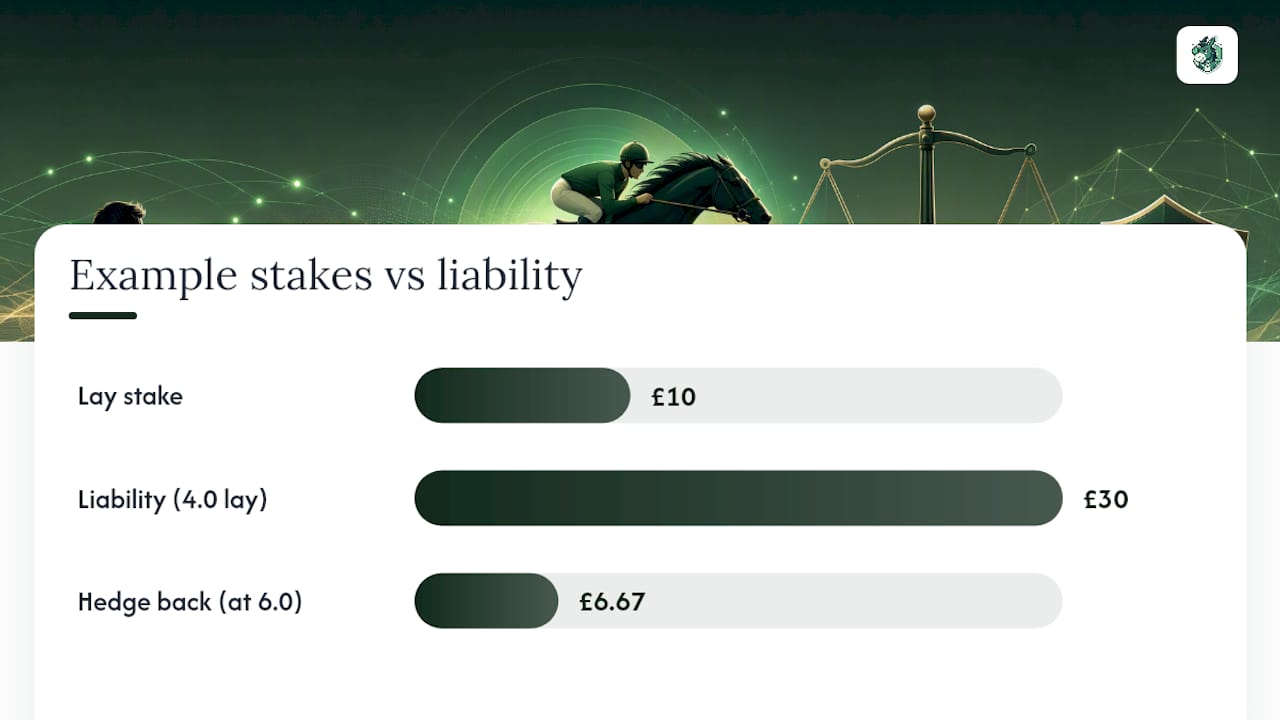
Liability is the money you stand to lose if your selection wins, and it’s larger than your stake, which is the single biggest thing new layers misjudge. The formula is straightforward: Liability = (lay odds − 1) × stake. Lay a horse at 4.0 for a £10 stake and your liability is £30, not £10. Get comfortable with that number before you place a single lay.
Two staking approaches dominate among disciplined layers:
- Fixed-liability staking: decide your maximum acceptable loss per bet (say £20) and work backwards to set the stake for whatever odds you’re facing.
- Percentage-of-bank staking: cap liability at a fixed percentage of your total laying bank, typically 1 to 3%, so a losing run doesn’t compound into a wipeout.
Commission changes the sums too. Betfair takes a cut of net winnings, not turnover, but that still raises the effective strike rate you need to break even, and the effect is sharper at longer odds where a single loss wipes out several wins’ worth of profit. Mid-range odds, roughly 2.5 to 6.0, tend to suit layers best: liquidity is deeper, liability is manageable, and the break-even strike rate sits at a level a well-selected shortlist can realistically clear.
Hedging locks in a result rather than leaving it to the race. Lay a horse at 4.0 for £10 (liability £30), and if it later trades up to 6.0, backing it at that price for roughly £6.67 cancels the liability and banks a small guaranteed profit regardless of the outcome. DonkeyRadar’s lay betting calculator does this arithmetic instantly, and the fixed-liability staking guide walks through the rules in more depth.
Execution: timing, market monitoring and practical tools
Timing decides whether a well-chosen lay actually turns a profit. Watch the price in the thirty minutes before the off: a favourite drifting from, say, 3.0 to 4.5 is often confirming what your checklist already told you, and there’s a real decision to make about entering before the drift completes or waiting for it to settle. Enter too early and you lock in a worse price than the market eventually offers; wait too long and the value can evaporate as other layers pile in.
In-running lays offer a shorter, sharper window. A favourite that jumps poorly, gets checked for room, or shows early signs of struggling can drift dramatically in seconds once the in-play market reacts, but execution speed matters enormously here. A slow connection or a laggy app costs you the price you actually wanted.
A few practical points worth building into your routine:
- Exchange order types, including persistence and “keep” instructions, let you place a lay that survives an in-play switch without manual intervention.
- Real-time alerts flag drifters the moment they move, which matters far more in large fields where you can’t watch every price manually.
- Trading software and API access let you automate parts of the monitoring, though the decision to commit liability should stay yours.
- Set a stop-loss level before the race starts, not during it, and treat hedging as the disciplined exit rather than a panic move.
DonkeyRadar’s step-by-step guide to laying a horse on Betfair covers the mechanics of order placement in more detail.
Common errors, psychology and record keeping
Laying favourites has an unusual psychological shape: you win often, in small increments, and lose rarely but for much larger amounts. That pattern rewards patience and punishes overconfidence, because a long winning streak can make a bettor casual about the one race that actually goes wrong.
The recurring mistakes are predictable once you’ve seen them a few times:
- Placing a lay without calculating liability first, then being surprised by the size of the loss.
- Chasing a loss by doubling the next stake to “get it back,” which turns one bad race into a bad week.
- Ignoring race context entirely and laying every favourite mechanically, regardless of field size or ground.
- Abandoning a sound selection process after two or three losses that were simply bad variance, not bad judgement.
Keep a record after every lay: the odds taken, the stake, the liability, your stated reason for the selection, the outcome, and one honest line on what you’d do differently. Systematic tracking over time reveals which trainers, courses, and race types actually produce your edge, rather than relying on memory or gut feeling.
Scale up only once you’ve got a genuine sample size behind you, ideally 50 to 100 lays, and treat a losing run beyond your normal variance as a signal to pause and review your checklist, not to increase stakes.
Pro Tip: Review your losing lays more carefully than your winning ones. A win tells you the selection worked; a loss tells you whether your process has a hole in it.
DonkeyRadar evidence: how algorithmic signals and verified results support practical laying
An algorithm can process historical strike rates and live market prices to flag potential weak favourites across UK, Australian, and US racing before the race starts. Every signal is published ahead of time, and results are tracked and verified publicly, which means you’re not being asked to take strike-rate claims on trust.
A practical workflow looks like this:
- An alert lands via email or Telegram flagging a lay candidate ahead of the off.
- Run the horse through your own checklist (form, trip, going, class, headgear) rather than acting on the alert alone.
- Size your liability using the calculator or the staking tier grading on the dashboard.
- Place the lay directly through the linked Betfair Exchange access, or set an alert to monitor pre-off drift.
Automated signals process far more data than a person can manually before every race, but they’re an aid to a disciplined process, not a replacement for one. The published results history lets you check whether the model’s strike rate across specific odds bands and race types matches the sort of laying you’re planning, which is a more useful test than any single headline figure.
Author perspective: when I use laying and when I sit it out
I stick to one meeting at a time and set a liability cap before racing starts, not after the first result. That discipline matters more than any single selection. On busy Saturday cards I’ve watched myself get tempted to lay three or four favourites in quick succession purely because the first one won; that’s the moment to stop, not accelerate.
My rule is simple: if a favourite passes fewer than four checklist points, it’s a candidate. If it passes more, I leave it alone regardless of the price. Test small, keep honest records, and let the numbers tell you whether the process is working.
— Donkey
How DonkeyRadar can help: guides, calculator and trial
A practical next step once you’ve got the selection and staking logic straight is to use a platform that provides daily lay signals, real-time alerts, direct Betfair Exchange links, staking tier grading, and a fully public results history, so every claim about strike rate is checkable rather than assumed.
Start with the lay betting calculator to get your liability maths right before you place a single lay, then read the complete lay betting guide if any part of the mechanics still feels unclear. The free tier covers daily signals, and the seven-day trial gives access to real-time alerts and the full verified results archive, which is the fastest way to see whether the algorithm’s picks match your own checklist before you commit to a paid subscription. Profits from betting in the UK are also tax-free, which sharpens the appeal for anyone treating this as a genuine long-term edge rather than a one-off flutter.
Further reading and primary sources
For safer gambling guidance, GambleAware is the recognised UK resource and worth bookmarking regardless of how disciplined your staking is. DonkeyRadar’s own beginner’s guide to lay versus back betting and false favourites guide both expand on points covered here. For wider market context, Racing TV’s explainer on lay betting and the Betfair exchange strategy overview are both worth a closer read.
Sources
- Lay betting guide — OddsPortal
- Betfair exchange horse racing strategies (2026) – Lay data
- GambleAware