← Blog · 📝 Article · 2 September 2026
5 Defence First Questions for Race Selection When Laying Horses
The best lay bets come from races where several independent signals agree a horse is beatable and the price still leaves room for profit. Favour handicaps with a sufficient number of runners, mid-range odds, and a liability you can afford to lose without touching your bank. DonkeyRadar builds its entire signal process around this filter, and it is the single habit that separates disciplined lay bettors from the ones chasing losers.
TL;DR:
- Focus on race selection by targeting large-field handicaps, festival meetings, and unsettled markets to maximize lay profit opportunities while avoiding small, illiquid, or predictable races.
- Set strict liability caps based on a percentage of your bankroll before racing to maintain discipline and prevent excessive losses during market volatility.
- Prioritize mid-range odds between 2.0 and 8.0, where the market is still unsettled, and independent evidence suggests a genuine edge, especially in races with favorable conditions and attributes.
- Use a defence-first checklist to exclude horses with multiple doubts related to pace, ground, course form, equipment, or jockey signals, ensuring that only strong lay cases are executed.
- Employ automated tools and algorithms for race filtering, market analysis, and liability calculation, combined with pre-race placement and in-play strategies, to uphold disciplined, informed betting.
Table of Contents
- What is race selection for lays, and why it matters more than horse selection
- Quick checklist: races to target and races to avoid
- Race-level criteria explained: field size, grade, going, course and distance
- Horse-level clues: form, course form, draw, pace and trainer/jockey signals
- Market signals, price and liability: how to read odds and decide if the price justifies a lay
- Staking and bankroll management for lay bettors
- Proven lay strategies: laying the favourite, lay-the-field, and in-play trading
- Defence-first checklist: the questions that can overturn a lay
- DonkeyRadar evidence and how our data-driven approach applies to race selection
- Step-by-step process: applying the checklist in real time
- Impact of different race types (flat, jumps, all-weather) on lay selection
- Assessing external factors such as weather changes or track biases
- Use of statistical models and software tools for race selection
- Timing of placement: pre-race vs in-play considerations
- Why disciplined, defence-first laying beats chasing systems
- DonkeyRadar: tools and pages to help you choose races to lay
- Sources
What is race selection for lays, and why it matters more than horse selection
Race selection for lays is the process of choosing which races even qualify for a lay bet before you look at a single runner. Get this step wrong and no amount of form study saves you. Most bettors do it backwards: they spot a horse that looks weak, then go looking for a race to put it in. That is the wrong order entirely.
Lay betting means backing a horse to lose rather than win, typically done on an exchange where you take the role of the bookmaker for that selection. If it loses, you win the backer’s stake. If it wins, you pay out at the odds agreed, which is why liability, not just probability, has to sit at the centre of every decision.
The trap most new lay bettors fall into is treating “obviously weak horse” as the whole strategy. It isn’t. A horse racing lay tips analysis makes the point plainly: a horse can look hopeless on paper and still be a bad lay, because the market has already priced in that weakness. If a no-hoper is trading at 40.0, the lay offers almost no value and carries outsized liability risk for a tiny return. Race selection is what filters out these false positives before you ever study a runner’s form.
The standard industry term for this discipline is “selective lay betting” or “value-based lay selection”, and it rests on one question: does this specific race, on this specific day, give me enough independent reasons to believe the market has got something wrong?
Quick checklist: races to target and races to avoid
Card scanning goes faster once you know exactly what you are hunting for and what to scroll straight past.
Target these race profiles:
- Competitive handicaps with a moderately large field, where the ratings spread is tight enough that no single horse dominates on official figures.
- Festival and feature meeting races with strong liquidity, since deep markets let you get matched at your price without excessive slippage.
- Races where the market itself is unsettled, shown by multiple horses trading at relatively short prices with no outright market leader clearly dominant.
Avoid these setups entirely:
- Small-field races, where a single withdrawal or slow start can flip the whole complexion of the market.
- Illiquid markets, particularly lower-grade jumps meetings on weekday afternoons, where getting matched at a fair price is unreliable.
- Top-class pattern races with a dominant, in-form favourite; these often have justified short prices rather than mispriced ones.
Pro Tip: Set a hard per-race liability cap before you open the racecard, not after you’ve found a horse you fancy laying. Deciding your maximum exposure in the heat of a shortening price is how disciplined bettors turn into undisciplined ones.
As a working guideline, treat odds between 2.0 and 8.0 as your sweet spot. Below 2.0, the liability per pound staked balloons; above 8.0, you’re often laying a horse the market has already dismissed, which limits your edge.
Race-level criteria explained: field size, grade, going, course and distance
Field size drives opportunity more than any other single factor. A race with fourteen runners spreads the winning chance more thinly across the field than one with six, which means more horses carry inflated prices relative to their real chance, and more genuine lay candidates exist within the same market. Competitive handicaps amplify this further, since the whole point of a handicap is to level the field on official ratings, making standout “certainties” rarer than in non-handicap company.
Going and distance change the stamina and speed profile of a race, and that shift can undo a horse’s recent form entirely. A horse that won comfortably on quick ground over a mile can look a completely different proposition on soft ground over a mile and a half. When conditions change materially from a horse’s last winning run, that’s a genuine lay signal, provided the market hasn’t already adjusted the price to reflect it.
Course quirks matter just as much as the raceday conditions:
- Tight, turning tracks such as Chester reward horses drawn well and penalise those who need room to build a rhythm, which can expose wide-draw runners regardless of their form figures.
- Camber and undulation, seen at tracks like Epsom, suit certain running styles and can undo horses who’ve only raced on flat, galloping circuits.
- Draw bias on certain configurations at tracks like Chelmsford City or Beverley consistently favours low or high stalls depending on distance, and ignoring that bias is one of the most common lay-selection errors.
Pro Tip: Check a track’s going bias tendencies before assuming recent form transfers cleanly. A course change is often a bigger factor than a formline suggests.
Course and distance suitability, in short, is where “good form” and “good lay case” most often diverge, and it rewards the bettor who checks both.
Horse-level clues: form, course form, draw, pace and trainer/jockey signals
Once a race clears the field-size and grade filters, the individual horse-level evidence decides whether a specific lay actually stacks up. Start with the basics: recent finishing positions matter less than the context behind them. A horse finishing third of six beaten favourites tells you far less than a horse finishing third of sixteen in a genuinely competitive handicap. Look at trip and class together, not separately. A step up in distance combined with a step up in class is a compounding weakness, whereas either factor alone might be manageable.
Key horse-level checks to run through:
- Formline speed figures against actual finishing position; a horse can finish second while running well below its previous figures, which the bare result won’t show.
- “Unproven at this course or distance” flags, which become decisive only when combined with at least one other weakness, not on their own.
- Draw and pace interaction: a horse drawn poorly for the likely early pace can be undone before the race even develops, but the reverse is also true, a poor form horse with a favourable pace draw can outrun expectations.
- Trainer and jockey signals, including a downgrade in jockey booking, a first-time visor or tongue tie, or a trainer’s yard running notably below its seasonal strike rate.
The draw and pace relationship deserves particular attention because it’s the factor most bettors skip. If three or four confirmed front-runners are drawn together, they can burn each other up early, handing the race to a hold-up horse that looked short of pace on paper. That single dynamic has overturned more lay cases than any formline ever will, and it’s exactly the kind of clue the horse racing data analysis approach is built to flag before the race, not after.
Equipment changes are a small detail with outsized meaning. A first-time hood or a switch to blinkers often signals a trainer has spotted something worth fixing, and it can be either encouraging or worrying depending on what problem it’s addressing. Treat it as a prompt to dig further, not a signal on its own.
Market signals, price and liability: how to read odds and decide if the price justifies a lay
Every lay decision comes down to one calculation: does the price on offer compensate you fairly for the horse’s real, non-zero chance of winning? A lay betting calculator does this maths automatically, but understanding it by hand sharpens your judgement on the racecourse.
The core formula is straightforward:
- Liability = (Odds minus 1) multiplied by your stake. Lay a horse at 5.0 for £10 stake, and your liability is £40 if it wins.
- Break-even win rate = 1 divided by odds, expressed as a percentage. At 5.0, the market implies a 20% winning chance; you need the true chance to be meaningfully lower than that to have an edge.
- Expected value = (implied losing probability × stake) minus (implied winning probability × liability). This tells you whether the lay is worth taking once you’ve formed your own view of the horse’s real chance.
Price movement before the race, often called drift or steam, is one of the most reliable secondary signals available. A horse drifting from 4.0 out to 6.0 in the hour before the off, without a stated reason such as a jockey change, often reflects informed money moving away from it, and that supports a lay case that was already forming on form grounds. Steam, the opposite movement where a price shortens sharply, should make you pause and recheck your reasoning rather than ignore it.
Laying it returns very little relative to the liability you’re carrying. The better lay targets are often mid-priced runners at 3.0 to 6.0 where the market is still unsettled and your independent evidence, from form, pace, and course fit, disagrees with the crowd’s assessment.
Staking and bankroll management for lay bettors
Percent-of-bank staking is the single most effective discipline a lay bettor can adopt, because liability scales with odds in a way that fixed staking simply doesn’t account for. A common approach caps total liability per race at 1% to 2% of your total bank, not the stake itself.
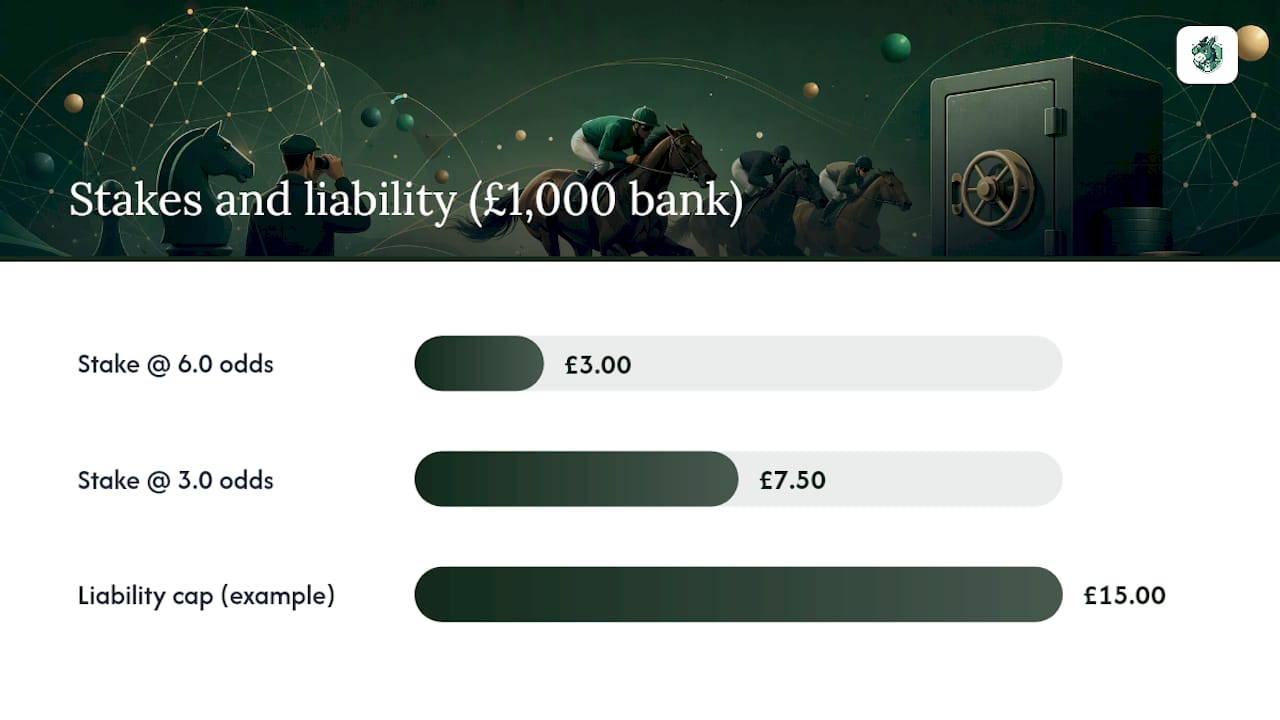
Take a £1,000 bank as an example. At odds of 6.0, that limits your stake to £3 (since liability equals stake multiplied by odds minus one: £3 × 5 = £15). At odds of 3.0, the same £15 cap allows a £7.50 stake. The higher the odds, the smaller the stake needs to be to keep liability constant, which is exactly why a flat stake-per-race approach is dangerous for lay bettors in a way it isn’t for back bettors.
Practical staking rules worth adopting:
- Set a fixed liability cap as a percentage of bank, then recalculate stake size for every odds level, never the reverse.
- Use a lay betting bankroll framework to track running exposure across a full card, not just race by race.
- Set a session loss limit, expressed as a fixed number of units, and stop entirely once it’s hit rather than trying to “trade back” the loss in the next race.
- Keep a simple recovery plan: after hitting a loss limit, take the rest of the day off and review the picks that lost before staking again.
Pro Tip: Track visible liability across your whole card in real time, not just at the point of placing each lay. It’s easy to stack four “small” liabilities that add up to a bank-threatening total by race five. Anyone managing exposure across multiple markets should also review GambleAware’s guidance on setting personal limits, since staking discipline and responsible-gambling limits work hand in hand.
Proven lay strategies: laying the favourite, lay-the-field, and in-play trading
Three core strategies dominate serious lay betting, and each suits different race conditions and different temperaments.
- Laying the favourite works best in competitive handicaps where the market leader hasn’t fully separated from the pack. Check that the favourite’s price implies a winning chance meaningfully higher than its form justifies, confirm the field size and liquidity are sufficient, then place the lay well before the off to get a fair price rather than chasing a shortening favourite in the final minutes.
- Lay-the-field involves laying several runners at a set price and backing out the ones that shorten later to lock in profit across the book. This strategy depends heavily on liquidity, since simultaneous matches across multiple horses increase total exposure quickly, and the mechanics of lay-the-field trading only work cleanly in markets deep enough to absorb your positions without moving the price against you.
- In-play trading means adjusting or exiting lay positions after the race starts, based on how the pace and running order actually unfold. This demands fast execution and a platform that shows queue position clearly, because a slow order update in a fast-moving in-play market is how good pre-race logic turns into an unwanted loss.
Liquidity is the thread connecting all three. Every one of these strategies depends on exchanges like Betfair offering enough depth in the order book to get matched at, or close to, your intended price, and thin markets undermine even the best-researched lay.
Defence-first checklist: the questions that can overturn a lay
Before confirming any lay, run the horse through five quick questions that specifically test whether it could still win, not whether it looks weak.
- Pace: could a lack of front-runners hand this horse an easy lead it wouldn’t normally get?
- Ground change: has the going shifted since its last run in a way that could suit rather than hinder it?
- Course form: does it have a hidden course-and-distance win that the recent formline doesn’t show?
- Jockey change: has a notably stronger rider been booked, particularly one with a good record at the track?
- Equipment: does a first-time visor, hood, or blinkers suggest the yard has fixed a known issue?
If two or more of these questions raise genuine doubt, skip the lay rather than force it. A horse with a hidden course win, a favourable pace scenario, and a leading jockey booking has overturned enough “obvious” lays to earn the benefit of the doubt.
DonkeyRadar evidence and how our data-driven approach applies to race selection
Every signal Donkeyradar publishes goes live before the race, not after, which is the only way a strike rate means anything. The platform’s algorithm runs historical strike rates and live market prices through the same defence-first logic covered above, filtering for field size, price band, and independent form weaknesses before a horse ever reaches the signal list.
Verification matters more than confidence here. Public result trackers, like the transparent P&L sheets common across serious tipping services, let you check settled results and strike rates independently rather than taking a claim on faith. Donkeyradar publishes its own verified results history for exactly this reason, alongside staking-tier grading and direct links to Betfair Exchange markets so the signal-to-execution gap is as short as possible.
The how to pick horses to lay checklist walks through this same evidence hierarchy in more detail, and it’s worth pairing with the race-level criteria above before trialling the signal service on a small stake.
Step-by-step process: applying the checklist in real time
A repeatable workflow beats a mental checklist you half-remember under time pressure. Run through these steps in order for every card:
- Initial filter: scan the card for races with eight-plus runners, competitive handicap status, and healthy market liquidity.
- Candidate shortlist: within qualifying races, flag horses with a market price between 2.0 and 8.0 that looks generous relative to recent form.
- Horse-level checks: run form, course form, draw, pace and trainer/jockey signals against each shortlisted candidate.
- Market check: confirm the price hasn’t already drifted to reflect the weakness, and note any steam that contradicts your view.
- Defence-first test: run the five overturn questions; skip if two or more raise genuine doubt.
- Place the lay: calculate liability against your bank cap, confirm the stake, and log it before the off.
Insert your staking and liability check between steps five and six every single time, never after placing the lay. A simple phone-note template covering “Race, Odds, Liability, Bank%, Overturn flags” takes seconds to fill in and removes the guesswork from a rushed final decision.
Impact of different race types (flat, jumps, all-weather) on lay selection
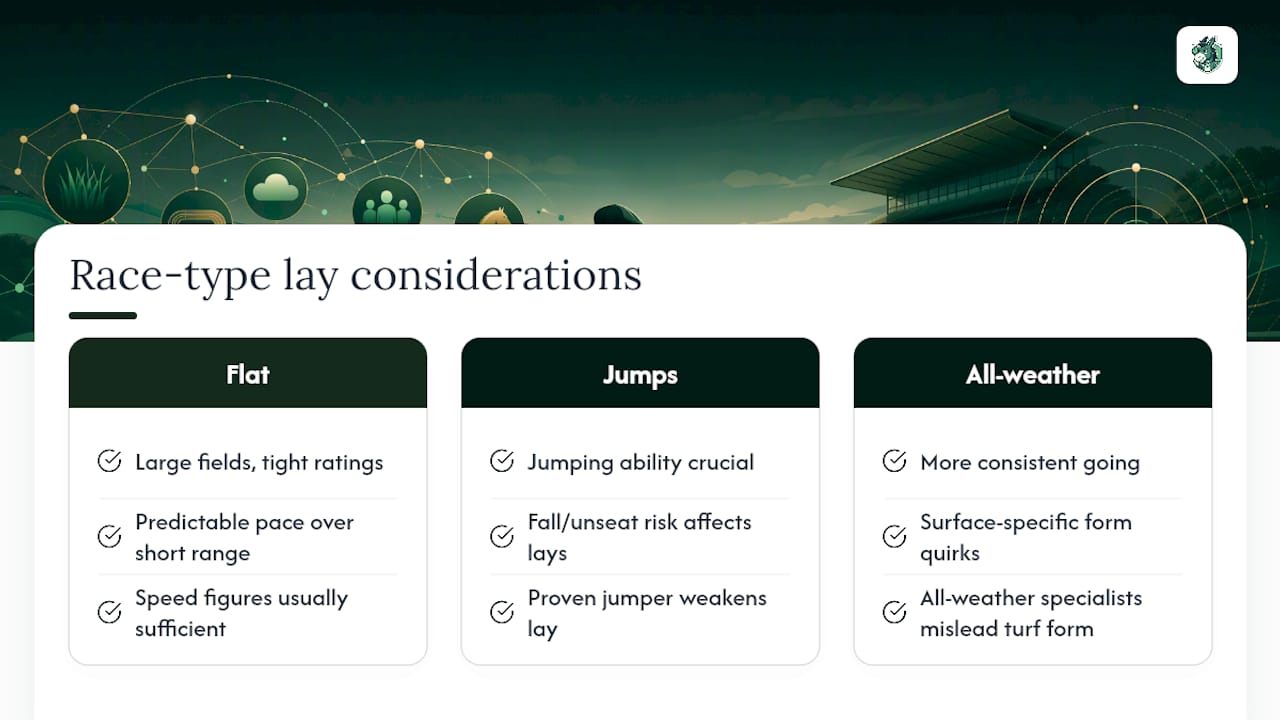
Flat racing, jumps racing, and all-weather fixtures each demand a different lens on the same defence-first principles. Flat handicaps tend to offer the cleanest lay opportunities because fields are often large, ratings are tightly compressed, and pace scenarios are more predictable across a shorter distance range.
Jumps racing introduces a variable that flat racing doesn’t have to the same degree: jumping ability itself. A horse can have flawless recent form on the flat-equivalent figures and still be a poor jumper, meaning fall or unseat risk becomes part of the lay case in a way that pure speed figures won’t show. This cuts both ways, since a poor jumper trading short is often a stronger lay than the figures alone suggest, while a proven, safe jumper at a generous price can be a weaker lay than it first appears.
All-weather racing, run on surfaces like Polytrack or Tapeta, tends to produce more consistent going conditions than turf, which removes one major variable from the equation but introduces surface-specific form quirks. Some horses are genuine “all-weather specialists” whose turf form undersells them completely, and missing that distinction is a common cause of misjudged lays on winter all-weather cards.
Across all three race types, the field-size and price-band guardrails hold steady, but the horse-level evidence you weight most heavily needs to shift with the code.
Assessing external factors such as weather changes or track biases
Weather in the days before a race can quietly undo a lay case built on outdated information. A meeting that was forecast soft and turns heavy overnight changes the stamina test significantly, and horses whose form was built on quicker ground can become considerably harder to lay with confidence, even if their price hasn’t moved yet to reflect it.
Track bias operates on a longer timescale but is just as important to check. Certain configurations develop a reputation over a season for favouring particular running styles or draw positions, often because of ground wear on one side of the track or a straight that rewards early pace over a sustained gallop. These biases show up gradually in results data rather than in any single race, which is why checking recent meeting-specific trends at a track matters as much as checking the individual horse’s own history.
The practical habit worth building is checking the going forecast and any recent bias notes for the specific meeting on the morning of the race, not the night before. Late changes in ground conditions are common enough that a lay case built on Tuesday’s forecast can look completely different by Saturday’s actual going description. Treat any last-minute going change as a trigger to re-run the defence-first checklist rather than assuming your earlier analysis still holds.
Use of statistical models and software tools for race selection
Manual form study still has a place, but statistical models process far more historical data points, more consistently, than any human scanning a racecard by eye. The core value of a model isn’t that it removes judgement entirely, it’s that it applies the same weighting to field size, price band, pace scenario and course fit every single time, without the fatigue or bias that creeps into manual selection after a long card.
Donkeyradar’s own approach reflects this: the algorithm processes historical strike rates alongside live market prices, generating signals before the race rather than retrofitting a story after the result. That “before, not after” distinction is the single clearest sign a tool is doing genuine analysis rather than narrating hindsight.
Software tools built for lay bettors typically combine a few core functions worth looking for: a signal or shortlist generator based on historical data, direct market integration so you can see live odds against the model’s assessment, and a liability calculator to translate the signal into a properly sized stake. The horse racing data models approach layers these together so a reader isn’t left doing the arithmetic manually mid-card.
Whatever tool you use, treat its output as a shortlist generator, not a final answer. Every model-generated signal still deserves the same defence-first questions applied by hand before you commit a stake, because no model has visibility into a same-morning jockey change or a going downgrade announced an hour before the first race.
Timing of placement: pre-race vs in-play considerations
Placing a lay well before the off gives you the calmest decision-making conditions and typically the fairest price, since you’re not competing against a rapidly narrowing order book. It also gives you time to run the full defence-first checklist properly rather than rushing it against a countdown clock.
Placing closer to the off, in the final ten to fifteen minutes, lets you factor in late market moves, confirmed non-runners, and any last-minute equipment or jockey changes that wouldn’t have been visible earlier. The trade-off is a thinner window to react and a market that can move quickly against you if a well-backed horse suddenly attracts a flurry of support.
In-play placement is a different discipline entirely. Once the race is running, your decision is based on live pace and positioning rather than pre-race form, and it demands quick execution since prices can move dramatically within seconds of a leader looking beaten or a hold-up horse making ground. Queue position matters enormously here. Market structure and order-book depth determine whether your in-play lay actually gets matched at the price you’re seeing, or whether the price moves past you while your order sits unfilled.
A sensible approach for most bettors is to do the analysis pre-race, place the bulk of lays in the ten-minute window before the off once the field is confirmed, and reserve in-play trading for situations where you’re actively watching the race and can react in real time.
Why disciplined, defence-first laying beats chasing systems
Every serious lay bettor eventually meets the same psychological trap: chasing a loss by upping the next stake, or abandoning a sound method after two losing races in a row because it “felt” wrong. Neither reaction has anything to do with whether the method was actually sound. Discipline solves this problem by removing the in-the-moment decision entirely, replacing it with a checklist you committed to before you were emotionally invested in the outcome.
Verified public results matter because they force honesty that a private tipping sheet never has to face. Check a service’s track record against real settled outcomes before trusting its strike-rate claims. Pick one method, test it with proper staking discipline, and let the results speak before adding a second system on top.
— Donkey
DonkeyRadar: tools and pages to help you choose races to lay
Applying every rule in this piece by hand, race by race, is exactly the kind of repetitive filtering that costs bettors time and, more often, discipline under pressure. Donkeyradar was built to run that defence-first filter for you, publishing lay signals before races start rather than dressing up hindsight as insight, with every result tracked and verified in the open afterwards.
The how to pick horses to lay checklist mirrors the race-and-horse criteria covered above, and the lay betting calculator handles the liability and break-even maths automatically, so you’re never sizing a stake on guesswork mid-card. Profits from betting in the UK are tax-free, which sharpens the appeal of a disciplined edge once you’ve got one worth trusting.
Start with the free tier to see daily signals and staking tiers in action, then compare a single race yourself against the public results tracker before deciding whether the premium alerts and API access are worth adding. If you’re new to the mechanics entirely, the lay betting explained guide is the clearest starting point.
Sources
- Why lay betting isn’t as easy as finding a losing horse - Racing Ahead Magazine
- Lay the Field Strategy: How to Trade Horse Racing Without Picking a Winner | Traderline
- GambleAware
- Betfair