← Blog · 📝 Article · 21 September 2026
Morning Line Lays: DonkeyRadar's £29 Pro Signals and Liability Routine
Morning Line Lays: DonkeyRadar’s £29 Pro Signals and Liability Routine
Morning line lays are pre-race signals published early in the day that flag which runner in a race is statistically likely to lose, giving you time to place a lay bet on an exchange before the market tightens. They work best when treated as a starting point, not a certainty: paired with sensible staking and an understanding of exchange mechanics, they can shift the odds in your favour over a season, not every race. Betting exchanges and lay tip services are commonly used once you start applying lay betting methods.
TL;DR:
- A morning lay signal is only reliable if multiple independent signals, such as trainer form, jockey fit, recent class exposure, and market price gaps, align simultaneously.
- Liquidity fluctuations and price drift between early morning signals and race start can cause mismatches, so market conditions should be checked again before placing a lay.
- Responsible staking involves capping liability at 1% to 5% of your bankroll per lay, with a focus on maintaining disciplined stop-loss rules instead of chasing losses.
- A typical profitable strike rate for long-term laying is around 85%, assuming proper liability management, commission considerations, and consistent performance tracking.
- Using verified signal services like Donkeyradar can help automate the process, but success depends heavily on disciplined risk controls and continuous market awareness.
Table of Contents
- How lay bets work on exchanges and why that matters for morning signals
- What data points make a morning lay credible?
- How much should you stake on a morning lay?
- Building a morning routine for placing lays
- Donkeyradar’s approach: how the signals work and how to check them
- What the data actually says about morning lay signals
- Try Donkeyradar for your morning lays
- Sources
- FAQ
How lay bets work on exchanges and why that matters for morning signals
A lay bet is a bet against a horse. Instead of backing a runner to win, you’re offering odds for someone else to back it, which means you win if the horse loses and you pay out if it wins. Your liability, the amount you stand to lose, is calculated as (lay odds − 1) × lay stake, and exchanges reserve that liability the moment you place the bet, before it is even matched.
Say you lay a horse at odds of 4.0 for a £10 stake. Your liability is (4.0 − 1) × £10, which comes to £30. Win the lay (the horse loses the race) and you collect your £10 stake, minus a small commission on net winnings, typically around 2%. Lose it, and £30 leaves your account.
Behind the scenes, the exchange runs as an order book. Back and lay bets queue at different prices and get matched automatically, in the same way a stock exchange pairs buyers and sellers. This is where morning line lays live or die: liquidity and spread determine execution quality, and a signal published at 8am on a horse with thin morning liquidity might not get matched at your intended price by the time the race goes off.
A few mechanics worth locking in before you place your first morning lay:
- Liability is ring-fenced instantly, so you always know your maximum downside before the race starts.
- Unmatched lay orders sit in the queue and can be cancelled or left to run into Betfair Starting Price rules if you don’t manage them.
- Commission is charged only on net winnings across a market, not on turnover, which changes your break-even maths.
- Thin early liquidity on a race means your intended stake might only partially match at your chosen price.
Understanding this order-book behaviour is the difference between treating a signal as a tip and treating it as a trade. Our step-by-step Betfair walkthrough covers order types in more depth if you’re new to placing lays directly.
What data points make a morning lay credible?
A morning lay is only as good as the evidence behind it, and the strongest signals combine form data with market data rather than relying on either alone.
On the form side, look for:
- Trainer form at the specific track — some trainers have strong record patterns at certain courses and weak ones elsewhere.
- Jockey fit — a booking that looks like a mismatch (a big-race jockey on a moderate horse, or vice versa) often signals stable confidence, or the lack of it.
- Recent class exposure — a horse stepping up in class off a hollow win is a classic false-favourite trap.
- First-time-out runners and horses off a long layoff — both carry more uncertainty than the market price usually reflects.
On the market side, specialist bettors compare the morning price against a tissue price they’ve calculated independently, and a wide gap between the two is often the clearest tell that the public has overbet a name they recognise rather than a horse that deserves the price. Low early liquidity on a market can also distort the price temporarily, so volume checks alongside price-gap analysis help confirm whether a gap is genuine mispricing or just an early, thin market.
Odds bands matter too. Many experienced layers concentrate on the 2.5 to 6.0 range, where liability stays manageable and the required strike rate to stay profitable is realistic. Below 2.0, you need to be right an uncomfortably high proportion of the time just to break even.
Pro Tip: Grade your confidence by how many independent signals line up, not by how strongly you feel about one of them. A horse that ticks a trainer-form box, a jockey-fit concern and a price-gap all at once is a far stronger candidate than one that only ticks a single box, however loudly that box shouts.
Our guide to spotting false favourites breaks down these form checks in more detail if you want to build your own screening process.
How much should you stake on a morning lay?
Fixed-liability staking is the standard approach: decide the maximum amount you’re willing to lose on a single lay, then work backwards to the stake, rather than fixing a stake and letting liability float with the odds. A reasonable cap sits between 1% and 5% of your bankroll per lay, with recreational bettors generally sticking to the lower end of that range.
Laying a horse at 5.0 means liability of (5.0 − 1) × stake, so your stake caps at £2.50.
Odds under 2.00 deserve real caution. At those prices your liability per pound staked is small, but you need to win a very high proportion of your lays just to cover the occasions the horse actually obliges, which is exactly why most experienced layers stay above 2.5.
Practical risk controls:
- Set a session stop-loss, such as pausing after three consecutive losing lays in one meeting.
- Recalculate your stake after every result rather than reusing yesterday’s number.
- Factor commission into your break-even point before you decide a lay is worth taking.
Roughly 85% strike rate is the kind of figure a tracked, verified signal service needs to sustain for lay betting to be reliably profitable over the long haul once liability sizing and commission are accounted for. Our fixed-liability staking guide walks through bankroll rebalancing after losing runs in more depth.
Building a morning routine for placing lays
A repeatable routine beats reacting to signals ad hoc. Run through this before every race day:
- Review signals early, and log the timestamp, the morning odds shown, and available lay liquidity at that moment.
- Grade your confidence on each signal using the criteria above, then rank races if you’re working through several meetings.
- Set your order before you place it: stake, liability reserved, minimum lay volume you’re happy to accept, and your stop-loss trigger.
- Choose your order type, and decide in advance whether you’ll leave it unmatched into the off or cancel if it hasn’t filled.
- Log the result against your original signal so you can measure real performance over weeks, not just remember the wins.
Keep morning lays separate from any in-running trading you do. In-play signals move on visible distress in real time and need a different stop-loss discipline entirely.
Donkeyradar’s approach: how the signals work and how to check them
Some services build morning lay signals from algorithms that process historical strike rates against live market prices, publishing picks before the race rather than after.
These services often provide a dashboard with links to exchanges for each selection, a confidence grading for each signal, and real-time alerts via email or messaging apps. Results are tracked publicly and remain visible, allowing users to review performance over time before committing to staking.
What the data actually says about morning lay signals
The conventional advice on lay betting focuses almost entirely on finding the right horse to lay. That’s only half the problem. Every worked example in this guide shows the same pattern: the maths around liability, commission and stop-losses does as much work as the signal itself. A good signal with reckless staking loses money just as reliably as a poor signal with disciplined staking wins less than it should.
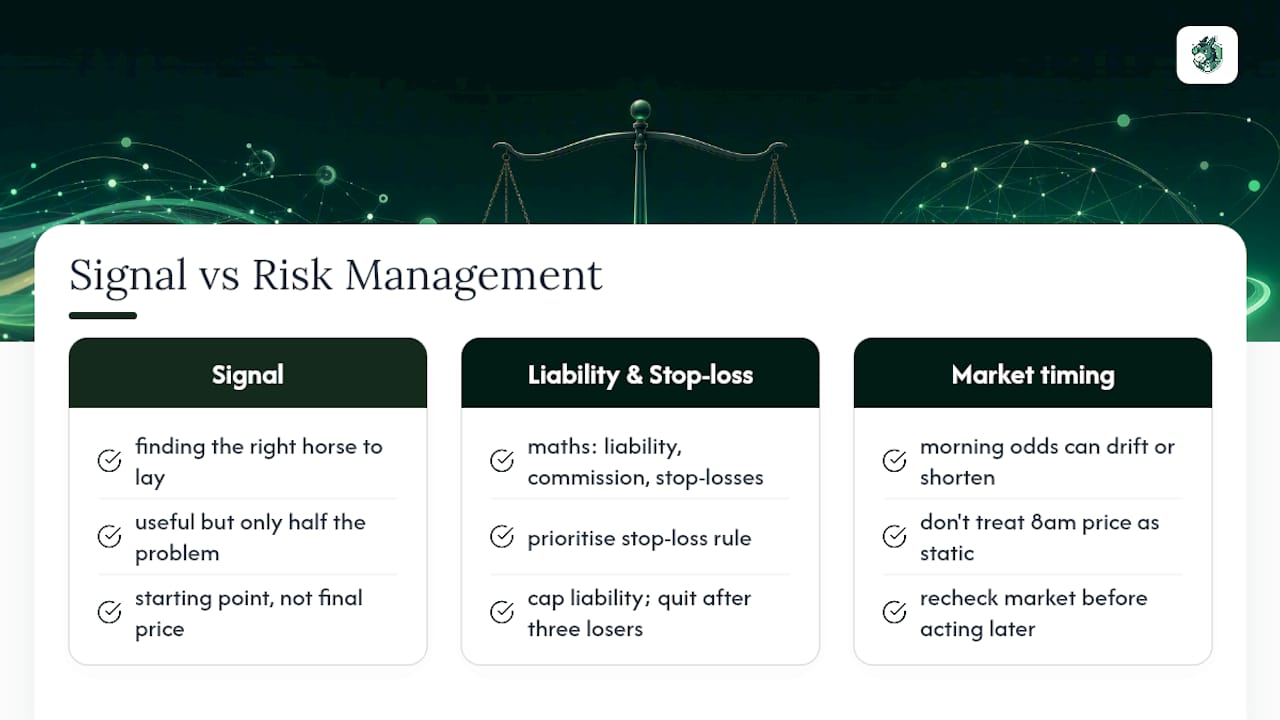
Where most guides fall short is treating morning odds as static. They aren’t. A price published at 8am can drift or shorten by post time depending on liquidity, so the signal is a starting point for research, not a number to act on blindly hours later without checking the market again.
If you take one thing from this guide, prioritise the stop-loss rule over the signal-picking criteria. Bettors who cap liability and walk away after three losers in a session survive long enough to let a genuinely strong strike rate play out. Bettors who chase losses on the next “obvious” favourite rarely get that chance.
— Donkey
Try Donkeyradar for your morning lays
Donkeyradar is the practical route for readers who want the checklist above delivered to their inbox rather than built from scratch every morning. Start with DonkeyRadar Free to see how the daily signals are structured and get comfortable with the dashboard, then move to DonkeyRadar Pro at £29 per month when you want real-time alerts, full results history, and API access for your own trading software, all available at Donkeyradar.
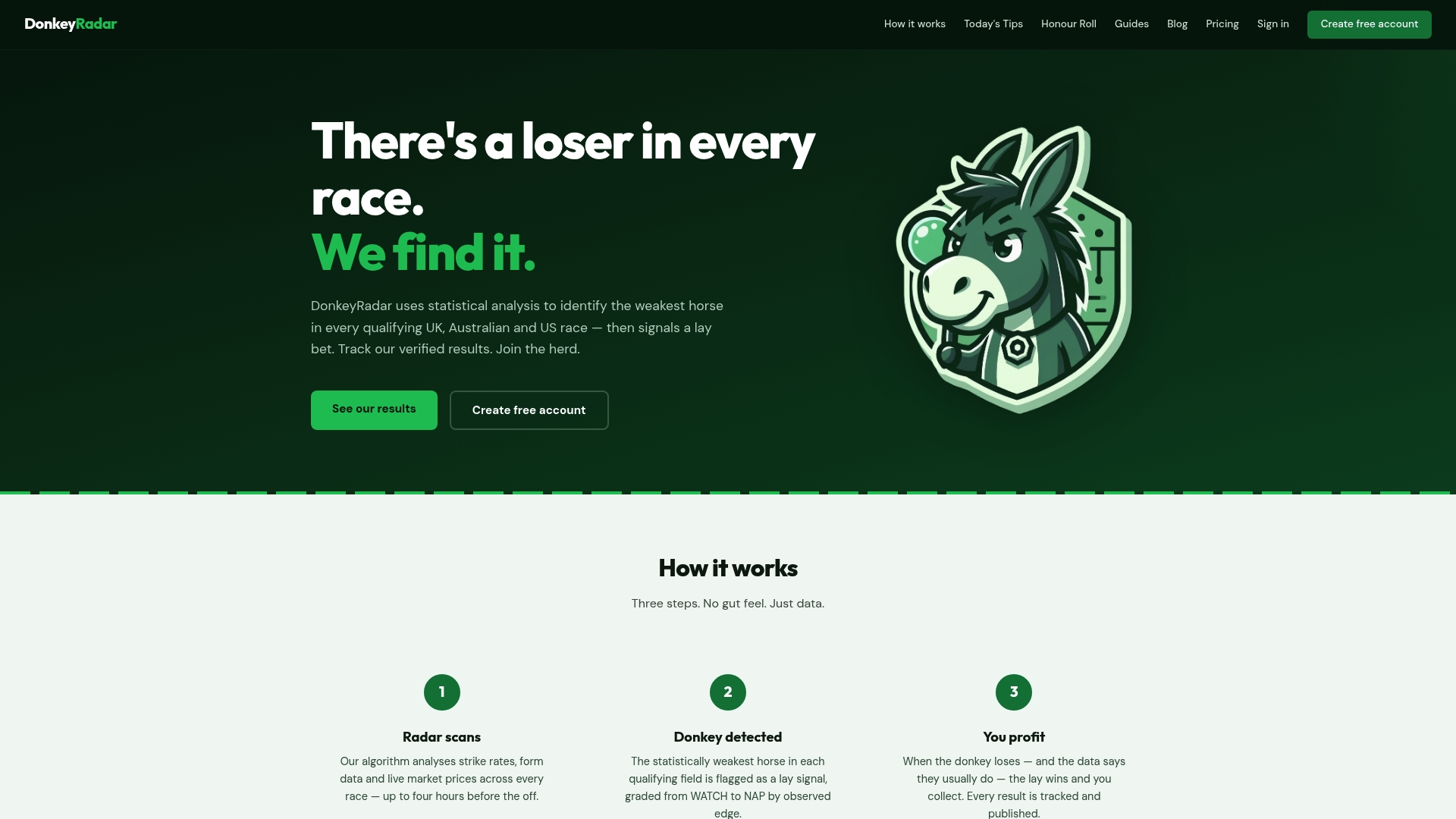
Getting set up takes a few minutes: sign up, set your liability cap using the staking rules in this guide, enable Telegram or email alerts, and find the verified results page before you commit a single pound. Test on small liabilities first, follow the stop-loss rules above regardless of how confident a signal looks, and let a few weeks of tracked results, not one race, decide whether the strategy earns a bigger stake. Our lay betting calculator is worth bookmarking for working out liability before you place anything.
Sources
- How to lay betting — Betfair
- How to make money laying horses — EveryTip
- How Betfair Exchange works — BetfairSquare
FAQ
What Does “morning Line Lays” Actually Mean?
It refers to pre-race lay signals published early in the day, identifying the runner a service expects to lose so you can lay it on an exchange like Betfair before the price tightens. It’s a forecast tool, not a guarantee.
Is Laying Horses Profitable Long-Term?
It can be, if your strike rate clears the break-even threshold set by your average odds and commission, and if you stick to strict staking limits. Services with a tracked, verified history, such as Donkeyradar’s published signals, let you check that the claimed edge holds up before risking real liability.
How Much Should I Risk On A Single Lay?
Most disciplined layers cap liability at 1% to 5% of their bankroll per selection, recalculating the stake after every result rather than keeping it fixed. Going higher than that turns a normal losing run into a serious dent in your bankroll.
Why Do Morning Odds Change Before The Race?
Prices move as liquidity builds and more money enters the market, so a gap between the morning price and the eventual starting price is normal, not a sign the signal was wrong. Checking available lay volume close to your entry time matters more than the morning number alone.
Does Donkeyradar Publish Results Before Or After Races?
Signals are published before races start, with results tracked and made permanently visible afterwards for verification. That transparency is part of what separates a credible signal service from an unverifiable tipping list.