← Blog · 📝 Article · 11 November 2026
Pre-Race Alerts for Horse Racing Lay Betting: How They Work

A pre-race alert is a message sent before a race starts that tells you something you can act on while the market is still open. In horse racing betting that usually means one of two things: a price-move marker on the exchange itself, or a signal from a service naming the runner it expects to lose. This guide explains both, shows how to act on an alert before the off, and covers the liability maths that keeps a lay bet under control.
We run DonkeyRadar, so our focus is lay signals for UK, Australian and US racing. The principles below apply to any alert you receive.
TL;DR
- A pre-race alert is only useful if it arrives before the market moves and tells you the runner, the race and the price range.
- Betfair’s own Beacons mark price moves in the market. Lay signals go further and name a runner to bet against.
- Always work out liability before you click: backer’s stake multiplied by (lay odds minus 1).
- Publishing signals before the off and keeping a public results history lets you judge any service on its record.
- Winnings are tax-free for UK customers, but only stake what you can afford to lose. Free support is open 24 hours on 0808 8020 133.
Table of Contents
- What a pre-race alert actually is
- When pre-race alerts arrive, and why timing matters
- Market alerts versus lay signals
- How lay betting works, in one minute
- Check liability before you act on any alert
- A step-by-step routine for acting on an alert
- Why a pre-published signal beats a hindsight tip
- Choosing which alerts to follow
- Try the alerts yourself
- Betting responsibly with alerts
- Tax on winnings
- FAQ
- Sources
What a pre-race alert actually is
The phrase covers more than one thing, so it helps to separate them.
Market alerts come from the exchange. Betfair’s Beacons are icons beside runners in horse racing win markets. A flame shows a heavily backed runner whose price is shortening. A snowflake shows a drifter. Betfair explains that a Beacon fires when the probability implied by the live price differs from an earlier anchor price by at least 7.5%. The anchor is set once a certain amount of money has been matched on the selection.
Signal alerts come from a service. They name a runner, the race, the time and the market position. In our case the runner is the one our statistical model rates as most likely to lose, so you can lay it on the exchange.
Personal alerts are the ones you build yourself: a phone alarm for the first race, a watchlist, a trading tool that fires when a price crosses a level.
All three share one job. They get your attention to the right race at the right moment, so a decision is made with a price in front of you and not in a rush at the off.

When pre-race alerts arrive, and why timing matters
Timing is the whole point of the word “pre”. Betfair says Beacons appear as soon as a market opens for betting, typically the evening before the race, and are recalculated in near real time, at least every 30 seconds. So a marker can appear, vanish and reappear as money comes in.
For a lay bettor this has practical consequences:
- Early prices are thin. Overnight markets have less money matched, so a price can look attractive and not hold.
- Mid-morning is when markets firm up. Most of the market’s information turns up once racing day gets going and stable and going reports are public.
- The last few minutes are the busiest. Large amounts are matched close to the off, which is when prices on the favourites and outsiders move most.
For that reason, a signal is worth more when it is published well before the race and when you know which price band it was built for. A signal that says “lay this runner” with no price guidance leaves you guessing. If you want the price side in detail, our guide on what odds to lay covers it.
Market alerts versus lay signals
It is easy to confuse a price-move marker with a recommendation. They answer different questions.
| Betfair Beacons | Lay signal | |
|---|---|---|
| What it tells you | The price has moved sharply | Which runner to bet against |
| Where it comes from | Live exchange prices | Statistical analysis of historical strike rates plus live market prices |
| Direction | Shortener or drifter | Lay the selected runner |
| Action needed | You decide what it means | You decide whether to take the bet and your stake |
A flame tells you that money has arrived for a horse. It does not tell you whether the horse will win. A lay signal is an opinion built on data, and every signal is a probability, not a certainty. That is why we publish ours in advance and record what happened afterwards.
How lay betting works, in one minute
On an exchange you can offer odds on a horse not winning. Another customer who thinks it will win takes the other side. As Sporting Life puts it, you are effectively the bookmaker for that selection: if the horse loses, you keep the backer’s stake, less commission.
The catch is the other side of the bet. If the horse wins, you pay out at the odds you laid. That is why liability, not stake, is the number that matters. If you are new to the idea, start with our plain-English guide to how lay betting works or the longer complete guide to laying horses on Betfair.
Check liability before you act on any alert

This is the step that separates a controlled lay from an expensive one. The formula is simple: liability equals the backer’s stake multiplied by lay odds minus 1. A £20 lay at 1.32 creates £6.40 of liability, according to the same source.
Here is how quickly it grows with price, using the same formula and a £10 backer’s stake:
| Lay odds | Liability | Profit if the horse loses (before commission) |
|---|---|---|
| 2.0 | £10 | £10 |
| 3.0 | £20 | £10 |
| 4.0 | £30 | £10 |
| 6.0 | £50 | £10 |
| 11.0 (10/1) | £100 | £10 |
The upside is the same £10 every time. The risk is not. This is why an outsider is not automatically a safe lay: a long price means a large liability. The exchange holds that liability from your balance until the result is known, as explained by a UK betting tools provider.
Two of our guides go deeper on this:
- Betfair lay liability explained for the mechanics.
- Liability staking for how to cap a single loss at 1 to 2% of your bankroll.
A good habit is to decide your maximum liability first and let the odds set your stake, not the other way round. If your cap is £10 and the lay price is 4.0, your backer’s stake is about £3.33, not £10.
A step-by-step routine for acting on an alert
When an alert arrives, work through the same short list every time.
- Read the race details. Course, time, runner, and the price range the signal was built for.
- Open the market on the exchange. Check the live lay price against the guidance. If it has drifted outside the range, skip it. There is always another race.
- Set your liability. Choose a fixed percentage of your bankroll, then work back to the stake.
- Check for non-runners and market changes. Betfair says customers should know the Exchange Rules affecting a market, including how non-runners and bets around the off are settled.
- Place the bet before the off. Use a limit order at your price. If it does not match, it does not match.
- Record it. Runner, price, stake, liability, result. Your own log is how you learn whether your execution matches the published results.
The Betfair rules also note that a starting-price bet with an odds limit may be unmatched or only partly matched, so know which order type you are using. Do not assume it filled.
Why a pre-published signal beats a hindsight tip
The weak point of any alert service is trust. A signal that appears after the race, or a record that quietly drops losers, tells you nothing. Three habits make an alert service checkable:
- Publication before the off. The signal exists, with a timestamp, before the result does.
- A permanent results history. Wins and losses both stay on the record.
- A clear price basis. You know what price the result was measured at.
We built DonkeyRadar around these. Every signal is published before the race, and results are tracked and verified publicly. Losses are listed too. It happens, and transparency is the whole point. Our own claim is a strike rate of over 85%, and the history is there for you to review.
A high strike rate on lays does not mean a lack of risk. Winning lays pay small amounts and losing lays cost a multiple of them, so a few losses can take back a lot of small wins. That is the reason we keep returning to liability caps in every guide, including our write-ups on handicap race favourites and jump racing lays.
Choosing which alerts to follow
Whether you use ours or anyone else’s, judge the alerts on the same points:
- Lead time. Does it arrive early enough for you to check the market and place a limit order?
- Price guidance. Does it say which odds band the model was built around? Our approach to this is covered in odds band lay predictions.
- Staking guidance. Does it help you size the bet, or leave you to guess?
- Delivery. Email and Telegram are quicker than a page you have to remember to open.
- Track record. Can you see every past result, not a curated selection?
- Coverage. Does it cover the markets you actually bet on?
DonkeyRadar covers UK, Australian and US horse racing. The dashboard includes direct Betfair Exchange links and staking tier grading, and the API lets you pass signals into trading software.
Our view on pre-race alerts
We think an alert is only as good as your ability to check it. That is why we publish every signal before the race and keep every result on a public history. We do not hide the losing days, because a lay bettor needs to see how losses and wins fit together over time.
Our signals come from statistical analysis of historical strike rates combined with live market prices, not from opinion. The aim is to find the runner most likely to lose and to hand you that information in time to act. The model finds the runner. Your liability cap decides how much a bad result can cost.
We also built the service so you are not tied to a manual routine. Real-time email and Telegram alerts, direct links to the Betfair Exchange and API access are there so signals can reach you, or your software, quickly and in a consistent format.
Donkey
Try the alerts yourself
DonkeyRadar Free gives you daily lay signals at no charge, so you can follow the format and see how signals are presented. DonkeyRadar Pro costs £29 per month and adds real-time alerts by email and Telegram, the full results history and API access. There is a seven-day trial for the paid plan.
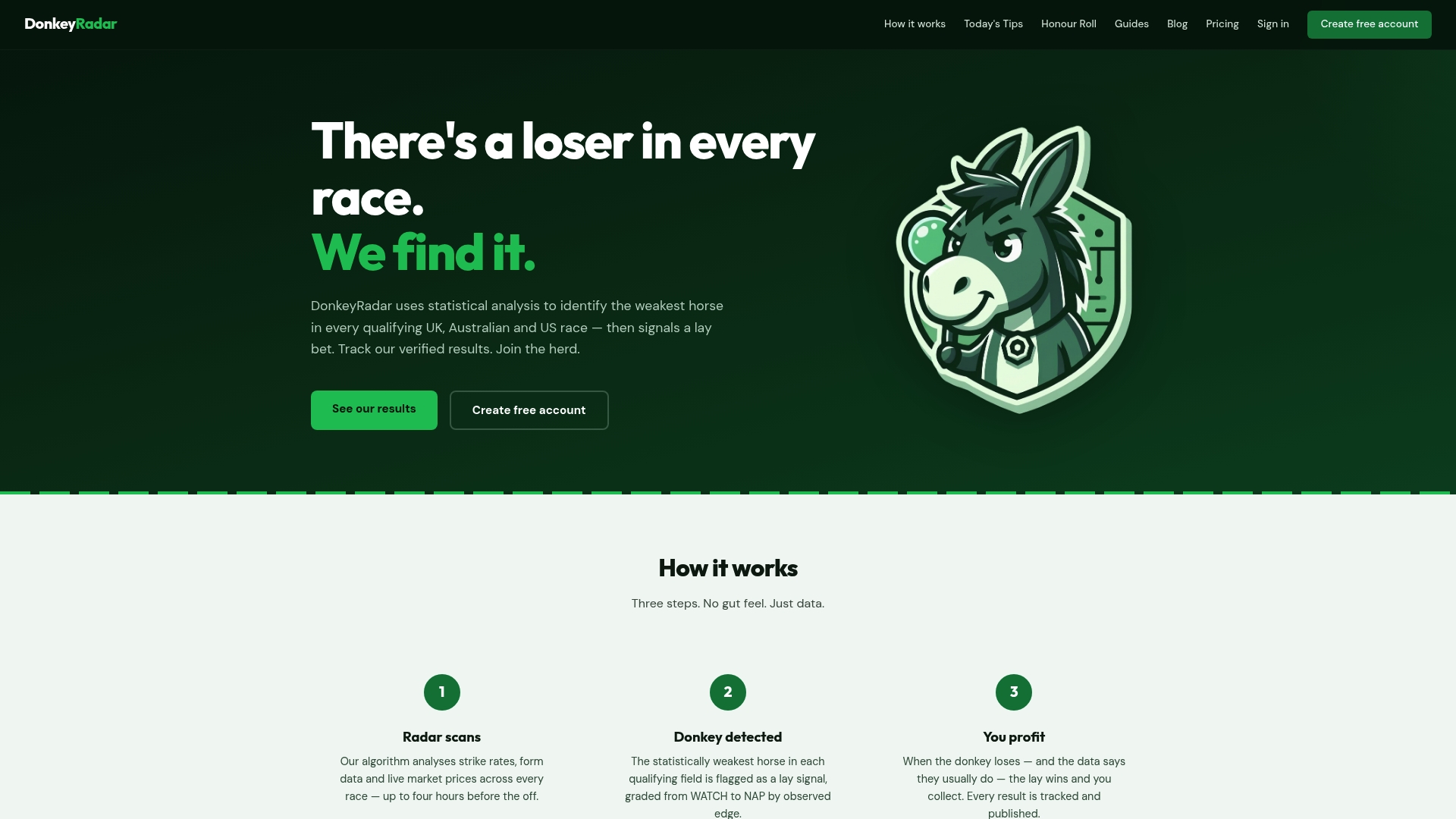
You can see both plans on the DonkeyRadar homepage, and if you want to see how we think about staking and selection first, read our Betfair lay betting strategy.
Betting responsibly with alerts
Alerts make acting fast and easy, which is exactly when discipline matters. Keep these rules in place:
- Only bet with money you can afford to lose, and treat betting as entertainment.
- Set a daily or weekly liability limit and stick to it, whatever the last result was.
- Do not chase a loss by increasing the next stake. A losing lay is part of the strike rate, not a debt to win back.
- Use the deposit limits and time-outs your exchange offers.
If gambling is causing you harm, the National Gambling Helpline, run by GamCare, is open 24 hours a day on Freephone 0808 8020 133 or by live chat, and gives confidential advice. GamCare’s industry code also points to the GAMSTOP self-exclusion scheme and gambling-blocking software for those who want to stop. Our service is for over 18s only.
Tax on winnings
For UK customers, the Gambling Commission states that gambling winnings are tax-free whatever the amount, because tax is charged on operators’ profits instead. That is the UK position only. If you bet from another country, check the rules that apply to you.
FAQ
What does a pre-race alert tell me?
A market alert such as a Betfair Beacon tells you a runner’s price has moved sharply. A lay signal tells you which runner a model expects to lose, in which race, and usually the price range to look for. Either way, you decide whether to bet and how much.
How early should a pre-race alert arrive?
Early enough for you to open the market, check the live price and place a limit order before the off. Markets open the evening before and firm up through the morning, so an alert that arrives with only minutes to spare leaves little room to check the price. Real-time delivery by email or Telegram helps.
Do I need a Betfair account to use lay signals?
Lay betting needs an exchange, because only an exchange lets you offer odds against a horse. Our dashboard links directly to the Betfair Exchange market. You place the bet yourself, or pass signals to trading software through the API if you want to automate it.
How much should I stake on a lay signal?
Start from your maximum liability, not your stake. Many bettors cap a single loss at 1 to 2% of their bankroll. Then divide that liability by (lay odds minus 1) to find the backer’s stake. Our liability staking guide has worked examples.
Are winnings from lay betting taxable in the UK?
No. The Gambling Commission says customer winnings are tax-free regardless of the amount. Operators pay the tax on their profits. Rules differ in other countries, so check yours if you are not betting from the UK.
Sources
- Betfair Beacons FAQs
- Betfair Exchange: Introduction and General Rules
- Sporting Life: lay betting on the Betfair Exchange
- How to calculate the liability of a lay bet
- What Is Liability?
- GamCare Industry Code for the Display of Safer Gambling Information
- Gambling Commission: winnings from gambling for customers