← Blog · 📝 Article · 22 September 2026
UK Bettors: Defence First Rules for Laying Weak Horses 2.0–6.0

Lay a horse when three things line up: the form shows genuine weakness, no credible defence explains away that weakness, and the price sits in a band where liability stays manageable. If any one of those three is missing, skip the race. Stick to prices roughly between 2.0 and 6.0, cap liability at a fixed percentage of your bank, and run the defence-first checklist below before you commit a penny.
TL;DR:
- Laying horses is most effective when the horse shows clear weaknesses in form, lacks credible defenses, and is priced between 2.0 and 6.0.
- Market structure strategies rely on the interplay of prices among multiple runners, with larger, competitive fields offering better opportunities.
- Race conditions such as pace, draw, course profile, and ground can significantly influence whether a horse’s weakness is a genuine or false signal.
- Managing liability by capping bets at 2 to 3% of the bank and avoiding chasing losses helps ensure long-term profitability.
- Using a structured defence checklist before placing a lay bet minimizes errors, focusing on pace, course suitability, recent changes, and last race explanations.
Table of Contents
- What makes a weak horse worth laying?
- How does market structure create lay opportunities?
- Which race factors strengthen or destroy a lay case?
- Odds bands, liability and staking: what protects your bank
- When should you place a lay bet and how do you avoid execution mistakes?
- What is the defence-first checklist before you lay?
- How DonkeyRadar turns this checklist into a data-driven signal
- How much do jockey and trainer form actually matter?
- Why do odds move on sentiment rather than evidence?
- What risk controls protect a lay betting bank long term?
- Author’s practical perspective: lessons from laying weak horses
- Try DonkeyRadar’s published lay signals
- Sources
- FAQ
What makes a weak horse worth laying?
A weak favourite and a false favourite are not the same animal, and mixing them up is where a lot of lay bettors lose money. A weak favourite is genuinely short in the market, but its recent form, weighted marks, or finishing history suggest it shouldn’t be. A false favourite is a horse the market has overpriced for reasons that have nothing to do with ability, such as stable confidence talk, a big-name jockey booking, or public sentiment following a previous win that flattered the horse’s true level.
The distinction matters because a false favourite can still have a genuine defence hiding in the data, while a weak favourite usually doesn’t.
Signals that build a credible lay case:
- Finishing margins that have widened across the last three to four runs, not just the most recent one.
- Inconsistent form across different tracks or ground conditions, rather than a single bad run explained by circumstance.
- Speed ratings or weighted marks that sit below the next two or three rivals in the field, despite the shorter price.
- Class rises without the form to justify them, particularly a step up after one flattering win in a weaker race.
- A trip or ground switch that hasn’t been tested, or was tested and failed.
Ambiguous evidence needs a second look rather than an instant lay. A horse that ran poorly last time but was caught wide on the home turn, or met unsuitably slow pace throughout, might have a legitimate excuse rather than a genuine weakness. DonkeyRadar’s data analysis approach weighs recent runs against course-specific patterns precisely because a single bad result rarely tells the whole story. If you’re unsure whether you’re looking at a weak favourite or a false one with a hidden defence, a closer look at false favourites is worth your time before you place anything.
How does market structure create lay opportunities?
Individual horse prediction matters less than most bettors assume. What actually drives lay profit is understanding how prices in a race move together, and where that collective movement creates an opening.
Odds in a race are interdependent. When money comes for one runner, prices across the rest of the field shorten or lengthen in response, because the market is redistributing implied probability, not just reacting to one horse. This is why reading the whole race, not a single selection, tends to produce better lay decisions.
Lay the field, a strategy that involves laying multiple runners across a race rather than backing a single loser, works best under specific conditions. Large, competitive fields with strong liquidity give the strategy room to operate, because market-structure approaches like this rely on active price interaction between many runners near the finish. In a five-runner race with one standout, there’s no structure to exploit. In a sixteen-runner handicap where four or five horses are realistically competitive, the field’s own uncertainty becomes your edge.
The mechanism, not the prediction, is what pays off here: lay-the-field strategies depend on liquidity and field size far more than on picking the eventual winner.
Practical signals worth watching in the run-up to the off:
- Prices tightening across several runners simultaneously, which suggests genuine market uncertainty rather than one horse’s price correcting.
- A widening spread between back and lay prices on your target horse, a sign liquidity is thinning and matching will get harder.
- Steady, gradual drift rather than a single sharp move, which usually reflects real information entering the market rather than a one-off bet skewing the price.
Pro Tip: Watch the market in the final 15 minutes before the off rather than hours out. Prices firm up meaningfully as more informed money enters, and early prices are often just noise from public perception rather than genuine assessment.
Which race factors strengthen or destroy a lay case?
Race-level conditions can turn an apparently weak horse into a live danger, and ignoring them is one of the most common ways a promising lay goes wrong. Work through these factors in order before you commit:
- Check pace and draw together. A poor draw on a tight, tactical track can force even a fit horse wide and out of contention, but a horse with a weak profile drawn well on a course that favours a prominent racing position can still get an easy lead and hang on.
- Assess field size honestly. Small fields of five or six runners rarely offer multiple realistic lay candidates. If there’s one obvious standout, the market has usually priced it correctly, and laying it just because it’s the favourite ignores the actual evidence.
- Match the runner to the course profile. Tight bends and short run-ins, common at tracks like Chester or Bath, reward horses that can dictate a race from the front or hold a rail position. That course profile can shield a weak stayer from being caught, because there simply isn’t enough room for a stronger finisher to pass late.
- Weigh camber and undulations. Uphill finishes, such as those at Cheltenham or Epsom, punish horses that lack a sustained gallop, which can strengthen a lay case that looked marginal on form alone.
- Combine race conditions with runner evidence, not instead of it. A weak horse drawn badly at a course that suits front-runners is a stronger lay than the same horse with a favourable draw and a course that plays to its style.
The mistake to avoid is treating course and pace factors as a tiebreaker rather than a filter. If the conditions clearly favour the horse you’re targeting, that alone can be enough reason to skip, regardless of how poor its recent form looks on paper.
Odds bands, liability and staking: what protects your bank
Target odds roughly between 2.0 and 6.0 for most lay bets on weak or vulnerable runners. Below 2.0, the reward rarely justifies the liability, because narrower odds bands mean you’re paying out a larger share of your stake relative to the winnings if the horse wins. Above 6.0 or 7.0, you’re often laying a horse the market has already correctly identified as an outsider, which adds risk without adding edge.
Worked example: laying a horse at 4.0 with a £10 stake creates a liability of £30 (stake multiplied by odds minus one). If the horse loses, as intended, you win £10. If it wins, you lose £30. That 3:1 risk-to-reward ratio is typical of the mid-band and is manageable if your overall staking plan accounts for it.
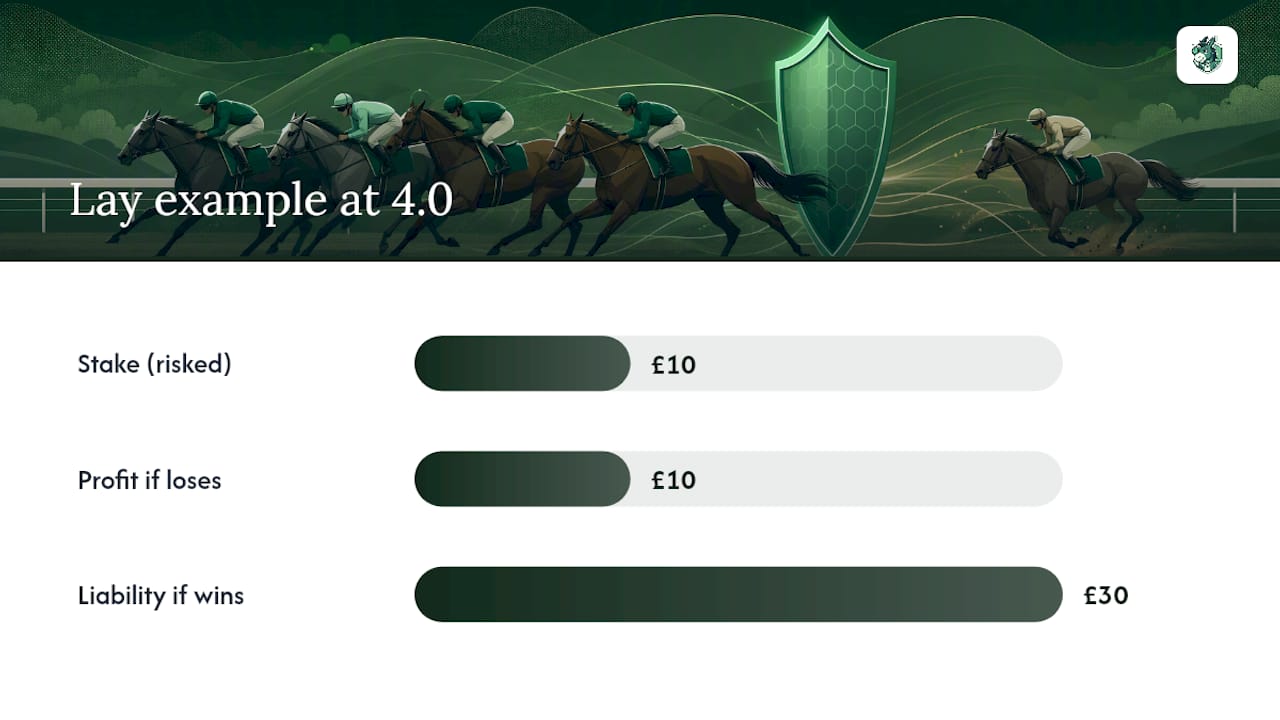
Compare that with laying at 1.8: a £10 stake creates only £8 liability, but the corresponding win if the horse loses is smaller relative to how often short-priced favourites actually win. Roughly 30 to 35% of favourites win their races, so laying at very short odds means you’re accepting a meaningfully higher hit rate against you for a proportionally smaller reward.
Liability management rules worth following:
- Cap any single lay’s liability at 2 to 3% of your total betting bank, regardless of how confident you feel.
- Use tiered staking, smaller stakes on marginal or first-time selections, larger stakes only once a selection type has a track record you trust.
- Never chase a bigger liability to make up for a previous loss; that’s how one bad lay wipes out a week of gains.
- Recalculate liability before every bet using a lay betting calculator rather than estimating in your head, especially at longer odds where the maths gets less intuitive.
Sometimes the odds look attractive but the liability still makes the bet unsafe. A horse at 8.0 might look like poor value for the layer on paper, but if your bank can’t absorb a £70 liability on a £10 stake without disrupting your staking plan for the week, the price alone doesn’t make it a good bet.
When should you place a lay bet and how do you avoid execution mistakes?
Pre-off lays give you time and better liquidity, but in-play lays can capture value that only appears once the race is underway. Each has a clear use case.
Pre-off betting suits horses where your evidence is strong and you don’t expect the price to move meaningfully in your favour. It also avoids the risk of a horse getting matched at a worse price once in-running markets go volatile. In-play betting, by contrast, works better when a horse’s weakness only becomes obvious once the race starts, such as a poor position at halfway or visible signs of struggling on the bridle.
Order placement is where a lot of bettors lose easy value without realising it. Round numbers like 5.0 or 10.0 attract heavy competing traffic on the exchange, which slows down matching and can leave your order sitting unfilled while the price moves past it. Slight odd offsets, laying at 5.1 rather than exactly 5.0, tend to get matched faster, because far fewer competing orders sit at those precise levels.
Practical execution habits:
- Place orders at odd, non-round prices to jump the automated queue that clusters around whole numbers.
- Watch for sudden volume spikes in the run-up to the off, they often precede a genuine price correction rather than random noise.
- Scale into a position gradually if the market is volatile, rather than committing your full stake at one price.
- Trim exposure early if in-running pace looks unusually slow, since a slow pace can help a weak front-runner defy its form.
Pro Tip: If your lay isn’t matched within a minute or two of the price you set, don’t chase it by moving to a worse price out of impatience. Either wait for the market to come back to you or walk away from that race entirely.
What is the defence-first checklist before you lay?
Every lay bet deserves five direct questions before you commit, because a structured defence-first habit is what separates a considered lay from a guess dressed up as analysis.
- Does the pace suit this horse? A slow, uncontested pace can flatter a weak front-runner regardless of its underlying ability.
- Does the course suit this horse’s running style? Tight, tactical tracks or uphill finishes can shield or expose a runner independent of its form figures.
- Has the jockey or training approach changed? A booking upgrade or a yard switch can signal genuine confidence that the public form doesn’t yet reflect.
- Has the ground shifted since the horse’s last run? A move to conditions the horse has previously handled well undermines an otherwise solid lay case.
- What actually happened last time out? A wide trip, a blocked run, or interference can explain a poor finish that has nothing to do with the horse’s real ability.
If two or more of these questions turn up a genuine, unresolved defence, the lay becomes a skip, not a smaller stake. A single-factor trap, laying purely because a horse is the market favourite, or purely because one number on a speed rating looks low, ignores the other four questions entirely and is how otherwise sound research turns into an avoidable loss. Only when the defences are absent or clearly weak across the board does the bet earn a play.
How DonkeyRadar turns this checklist into a data-driven signal
Running this checklist manually across a full card takes time most bettors don’t have, which is the gap a structured, data-driven process is built to close. DonkeyRadar’s signal pipeline applies statistical filters, including recent strike rate, weighted form, and market price behaviour, to flag horses that meet the weak-favourite criteria before applying the same defence checks a careful bettor would run by hand.
What that process gives you in practice:
- Signals published before the race, not after, so you can verify the call was made with the same information you had access to.
- A staking tier attached to each signal, reflecting how strongly the underlying data supports the lay.
- A permanently tracked results history, so strike rate and profit and loss figures are visible over time rather than cherry-picked.
- Direct links through to the Betfair Exchange, cutting the gap between signal and execution.
Modelling approaches that weigh course-specific patterns against recent form exist precisely because manual analysis, however careful, struggles to stay consistent across dozens of races a week. Transparency matters here too: responsible lay research should publish clear play or skip decisions and track verified results, because a service that only shows you its wins isn’t giving you the full picture.
How much do jockey and trainer form actually matter?
A change in jockey or trainer form can override what the horse’s recent figures suggest, and ignoring it is one of the more common ways lay bettors get caught out. A leading jockey taking a booking on a horse that’s been running poorly under a different rider often signals inside confidence that hasn’t yet shown up in the public form figures.
Trainer form works on a shorter cycle than most bettors credit. A yard on a hot run, several winners in the preceding fortnight, tends to be sending out fitter, sharper horses across the board, regardless of what any single horse’s last three results show. Conversely, a yard that’s gone quiet for weeks despite entering plenty of runners can be a sign of underlying issues that make even a previously reliable horse a safer lay than its price suggests.
The practical rule is to treat a jockey or trainer change as a standalone check, separate from the form-based signals covered earlier. A weak horse with a fresh, in-form jockey booking and a trainer on a winning streak has picked up a genuine defence that pure speed ratings won’t show you. On the other hand, a short-priced favourite from a struggling yard, ridden by a jockey who’s been off the boil for weeks, often confirms rather than contradicts a lay case built on form alone.
Why do odds move on sentiment rather than evidence?
Betting markets are driven by people, and people don’t always bet on evidence. Public sentiment, media coverage, and a horse’s name recognition following a previous big-race win can push a price shorter than the current form justifies, creating exactly the kind of false favourite covered earlier in this piece.
Recency bias is the most common sentiment trap. A horse that won impressively last time out often gets backed heavily next time regardless of whether that win came against weak opposition or in favourable conditions unlikely to repeat. The market, collectively, remembers the win far more vividly than it weighs the context around it.
Stable confidence talk works the same way. A trainer quoted as “having a big one” tends to shorten a horse’s price even when the formal figures don’t support it, because public money follows perceived inside knowledge whether or not that knowledge is reliable. This is where reading market movement matters more than reading a single quote: if the price shortens sharply on public sentiment but stays volatile with a wide back-lay spread rather than settling, that’s often a sign the smart money hasn’t followed the public money, and the shortened price may not hold.
What risk controls protect a lay betting bank long term?
Risk management for laying favourites needs to account for a specific asymmetry: your maximum loss on any single bet is far larger than your maximum win, which is the opposite of backing. That asymmetry demands discipline that backing strategies don’t require in the same way.
Core controls worth building into your process:
- Set a hard liability cap per bet, 2 to 3% of your total bank, and treat it as non-negotiable regardless of how strong a signal looks.
- Track results over a rolling sample of at least 50 to 100 bets before judging whether a particular approach or odds band is working, since short runs are dominated by variance.
- Diversify across races and days rather than concentrating exposure on one meeting, so a single bad card doesn’t disproportionately damage your bank.
- Review losing lays specifically for missed defences, not just bad luck, since a pattern of the same defence being overlooked points to a fixable process gap rather than randomness.
The Gambling Commission’s safer-gambling guidance is worth reading in full if you’re building a staking plan from scratch, because bank management principles that apply to backing apply equally, if not more urgently, to laying given the liability structure involved.
Author’s practical perspective: lessons from laying weak horses
Two lessons stand out from years of analysing lay signals. First, the biggest losses rarely come from bad data, they come from ignoring a defence you’d already spotted because the price looked too good to pass up. Second, small fields punish overconfidence; the fewer runners in a race, the more likely the market has already priced the weakness correctly.
The rule of thumb worth carrying into every session: if you can’t name the specific defence that would beat your lay, you haven’t finished your research yet.
— Donkey
Try DonkeyRadar’s published lay signals
There are other ways to build a defence-first shortlist, spreadsheets, manual form study, forum tips, but most of them ask you to do the pace, course, and jockey checks from scratch every single race day. DonkeyRadar’s edge is that the filtering happens before you see the signal: every pick has already been run through statistical form checks and published before the off, so you’re reviewing a shortlist rather than starting from zero.
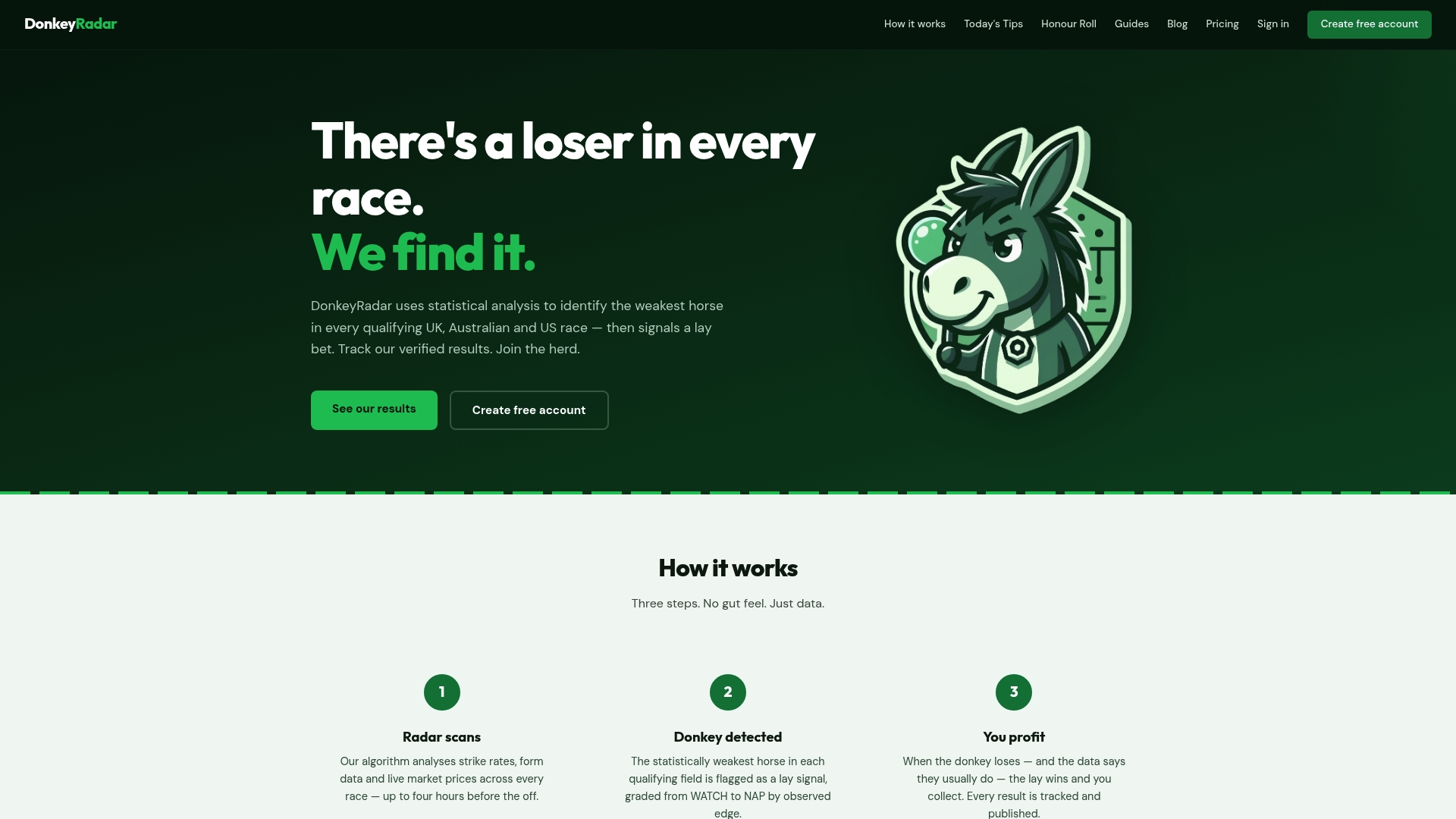
DonkeyRadar Free gives you daily lay signals at no published cost, a solid way to test the approach against your own judgement without committing anything. DonkeyRadar Pro, at £29 per month, adds real-time alerts via email and Telegram, full verified results history, and API access for anyone running their own trading software alongside the signals. Every signal on both tiers links directly through to the Betfair Exchange, and results are tracked publicly rather than curated after the fact.
If you’re new to the mechanics of laying itself, the lay betting explained guide is a solid starting point before diving into the signals. Ready to see today’s shortlist? Head to DonkeyRadar and check the published signals against the defence-first checklist yourself.
Sources
- Gambling Commission safer-gambling guidance
- Lay the field strategy – how market structure creates opportunities
- Why lay betting isn’t as easy as finding a losing horse
FAQ
Is laying the field a profitable strategy?
Lay the field can be profitable in large, competitive fields with strong liquidity, because the edge comes from market structure and price interaction rather than predicting a single winner. It performs poorly in small fields with an obvious standout, where there’s no real structural uncertainty to exploit.
What are the best tips for laying weak horses?
Focus on horses with widening finishing margins, inconsistent form across ground or trip, and no credible defence in pace, course fit, or recent jockey and trainer changes. Target odds roughly between 2.0 and 6.0 and always run the five-question defence-first checklist before committing a stake.
How can I tell if a horse’s poor run had a valid excuse?
Check whether the horse was caught wide, faced an unsuitably slow or fast pace, or ran on ground that didn’t suit it. A structured defence-first check is specifically designed to catch these excuses before you lay, rather than assuming a bad finish always means genuine weakness.
My horse is lying down and won’t get up. What should I do?
This is a veterinary emergency and has nothing to do with betting strategy. Horses normally lie down only briefly for REM sleep, and prolonged recumbency signals serious illness or injury, so contact a vet immediately rather than waiting to see if the horse gets up on its own.
Does DonkeyRadar publish its lay signals before the race?
Yes, DonkeyRadar publishes every signal ahead of the off, with results tracked and verified afterwards rather than curated after the fact. Free daily signals are available now, and DonkeyRadar Pro, at £29 per month, adds real-time alerts, full results history, and API access.